The Renewable Bioproducts Institute at Georgia Tech
Video Summary: Georgia Tech’s Renewable Bioproducts Institute (RBI) champions innovation in converting biomass into value-added products, developing advanced chemical and bio-based refining technologies, and advancing excellence in manufacturing processes. RBI’s three strategic thrusts are circular materials, bioindustrial manufacturing, and paper, packaging, and tissue. The Renewable Bioproducts Institute was formerly named the Institute of Paper Science and Technology.
RBI serves as a campus conduit for industry-university partnerships and provides a portal to Georgia Tech core laboratories, faculty, and students whose work and expertise is focused on biomass, bioproducts, and circular materials. RBI is one of ten campus interdisciplinary research institutes.
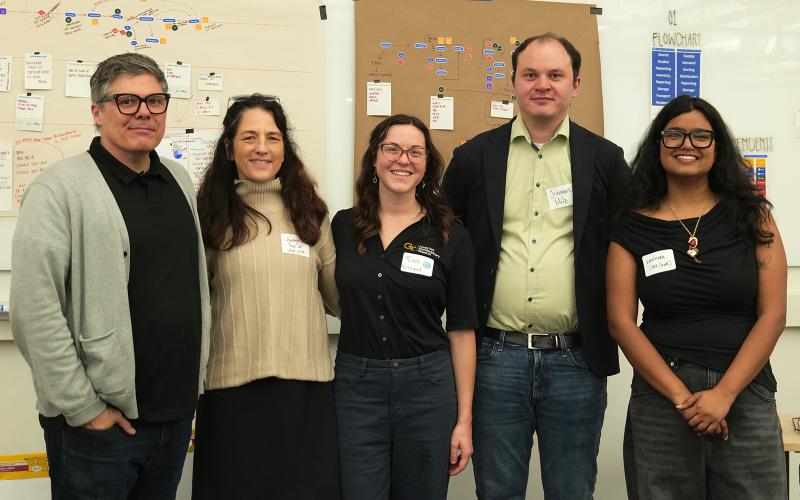
Speakers: Carson Meredith, Executive Director, Renewable Bioproducts Institute; Stefan France, Professor and Associate Chair for Graduate Studies, School of Chemistry and Biochemistry; Belinda Vogel, Research Engagement Manager, Renewable Bioproducts Institute; Blair Brettmann, Strategic Initiative Lead, Renewable Bioproducts Institute; and Chris Luettgen, Strategic Initiative Lead, Renewable Bioproducts Institute.
Carson Meredith, Executive Director, Renewable Bioproducts Institute: How I would describe RBI is that we are an interdisciplinary research community that's dedicated to next generation technology and to underlying science in converting renewable plants into products for society. RBI serves as the leader for industry, academia, government, and a lot of other agencies to try and act as a think tank and a means to fund and pioneer new technologies, new research, new chemistries, new science, things like that.
Stefan France, Professor and Associate Chair for Graduate Studies, School of Chemistry and Biochemistry: RBI is exciting because it's a really interesting area of research. It's really amazing what you can do with a plant in terms of turning it into a chemical or a substitute for plastic or something that's more biodegradable than other alternatives. One of the biggest strengths with Georgia Tech in renewable bioproducts research is that we have a huge community of faculty, students, and staff working in this area.
Belinda Vogel, Research Engagement Manager, Renewable Bioproducts Institute: We have a tremendous endowment that's coming up on a 100 years old now. And now our endowment is funding over 40 graduate students on full ride four-year fellowships. There's no other university in the country that can benefit from such an endowment like we do. By funding students through the idea of collaborative projects, it enables faculty to get together and actually think about research and brainstorm new projects, new directions in a way that actually can push science forward, but also supporting graduate students at the same time. I think that's phenomenal.
Blair Brettmann, Strategic Initiative Lead, Renewable Bioproducts Institute: The impact of RBI on people in the United States is, I think, around manufacturing jobs and reduced carbon emissions. By utilizing the natural resources we have, we can maintain manufacturing jobs in the United States. Because we have the best resources of any region in the world. I think the impact on people nationally in the United States of renewable bioproducts is similar to in the state of Georgia. Forestry is a big industry in Georgia, particularly in rural areas. And so figuring out new and different and more efficient ways to use those products helps industries that are important to the country and helps Georgia residents. We're able to improve our production and our manufacturing of things like pulp and paper and other products here in the US by making it cheaper, by making it use less energy. We can really improve our ability to manufacture at home rather than elsewhere.
Chris Luettgen, Strategic Initiative Lead, Renewable Bioproducts Institute: As you know, RBI is well known and has had a history of working with the pulp and paper industry and we continue to innovate in that space. But we're also doing so much more beyond that in developing new technologies, new ideas with the broader bioeconomy.